Why SEO Alone Is No Longer Enough in 2026
For the past two decades, the logic of digital visibility was relatively straightforward. Rank on the first page of Google. Optimise your keywords. Build backlinks. Earn traffic.
That foundation still matters. But the rules have shifted, and playing the old game is no longer enough.
A fundamental shift is underway in how people find information, make decisions, and discover brands. The change is not gradual. It is happening now, and its implications for marketing, brand strategy, and business growth are profound.
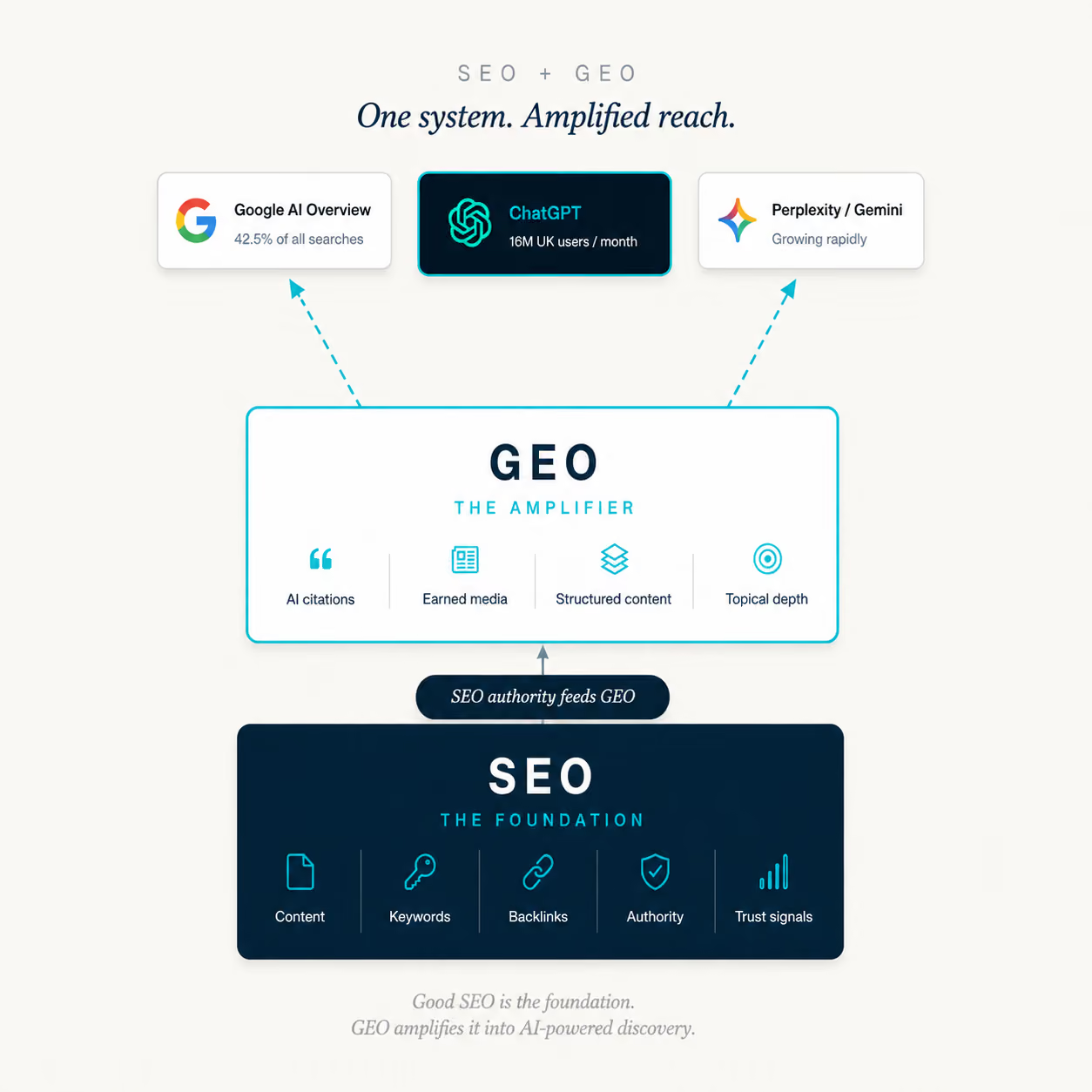
When someone asks ChatGPT to recommend a brand strategist, searches for a creative agency on Perplexity, or receives an AI-generated summary at the top of their Google results, they are navigating a search landscape that operates by entirely different rules from the one marketers have spent years optimising for. Ranking on page one still matters. But consider this: Google's AI Overviews now appear in 42.5% of all searches, sitting above every organic result you have worked to earn. ChatGPT alone has 16 million monthly users in the UK. And traffic arriving from AI search citations converts at 14.2%, compared to 2.8% from traditional organic search. The brands showing up in those AI responses are not just getting more visibility. They are getting better leads, faster decisions, and stronger authority. The real question now is not whether you rank on Google. It is whether the AI knows your brand exists at all, and whether it represents you the way you deserve.
This is the world of Generative Engine Optimisation, or GEO. And for any brand serious about visibility in the next five years, understanding it is not optional.
What Is Generative Engine Optimisation (GEO)?
Generative Engine Optimisation (GEO) is the practice of creating and structuring content so that AI-powered search tools (ChatGPT, Google Gemini, Perplexity, Microsoft Copilot, and others) discover, understand and cite your brand when generating responses to user queries.
Where traditional Search Engine Optimisation (SEO) is about ranking in a list of links, GEO is about being the answer. AI tools do not return ten blue links and invite the user to explore. They synthesise information from multiple sources and produce a direct response. If your content informs that response, your brand earns a kind of authority that no paid ad can replicate. If your content is absent, your brand simply does not exist in that interaction.
You will also encounter this practice under several other names: Large Language Model Optimisation (LLMO), Answer Engine Optimisation (AEO), AI Search Optimisation, and Generative Search Optimisation. The terminology has not yet settled across the industry, but the discipline is the same. For clarity, we use GEO throughout this article.
How Fast Is AI Search Growing, and Why Does It Matter?
To understand why GEO matters, it helps to understand how rapidly the search landscape is changing.
Google processes approximately 3.5 billion searches per day. ChatGPT alone receives hundreds of millions of queries every month, and that number continues to rise. In the UK specifically, ChatGPT has 16 million monthly active users, making it two to three times more popular than any other standalone AI tool. Google's AI Overviews, the AI-generated summary panels that now appear before traditional search results, are showing up in 42.5% of all search queries, and that proportion is expanding.
These are not niche shifts. They represent a structural change in where attention lives and where decisions are shaped.
Perhaps the most striking data point for any brand or marketing professional is this: traffic that arrives via AI search citations converts at 14.2%, compared to 2.8% for traditional organic search. The reason is intuitive. Someone who has asked an AI tool a specific question and received a direct recommendation is already further along in their decision-making than someone casually browsing a results page. AI search does not just deliver more traffic. It delivers better traffic.
What Is the Difference Between GEO and SEO?
GEO and SEO are not in opposition. They share the same foundational logic: produce high-quality, authoritative content that earns trust. But they differ significantly in how success is measured and how the underlying systems work.
SEO operates on a deterministic model. Algorithms evaluate your page against a set of ranking factors (content relevance, backlink authority, technical performance, user experience signals) and assign you a position. That position is relatively stable and observable. You can track it, test changes against it, and build a strategy around it.
GEO operates differently. Large language models synthesise responses from multiple sources. They do not return you a single ranked page; they draw on your content to construct an answer, alongside content from other sources. Your brand might be mentioned, cited, paraphrased, or absorbed invisibly into a response, and none of these outcomes appears in a traditional analytics dashboard. Importantly, research indicates that 80 to 90% of what AI tools cite comes from earned media: third-party coverage, authoritative references, external citations, rather than a brand's own website content alone. This has significant implications for PR and communications strategy, not just content marketing.
The key differences in practice:
Goal. SEO targets a ranked position in a list. GEO targets being cited, referenced, or used
as a source in an AI-generated response.
Content. SEO rewards keyword optimisation, meta structures, and page authority. GEO rewards comprehensiveness, directness, conversational clarity, and the ability to answer specific questions accurately and completely.
Measurement. SEO success is tracked through rankings and organic traffic. GEO success is tracked through AI citations, brand mentions in LLM responses, and the accuracy with which AI tools represent your brand.
Authority signals. Both value backlinks and credibility, but GEO places particular weight on earned media: the degree to which reputable external sources reference your brand, your thinking, and your work.
Why GEO Is a Brand Strategy Challenge, Not Just a Marketing Task
GEO is not merely a technical challenge for marketing teams. It is a brand strategy challenge, and for ambitious businesses, it presents a significant opportunity.
Consider the reputation dimension. When a potential client asks an AI tool about your company, your sector, or the type of service you provide, what response does it generate? That response is, in effect, your brand's first impression in a growing proportion of commercial conversations. If your brand is absent from AI responses, you are invisible in that channel. If your brand is present but inaccurately represented (a genuine risk given the probabilistic nature of large language models), your reputation is being shaped by a process entirely outside your control.
In an AI-first world, visibility belongs to the brands that move before it becomes obvious. The window to build that authority is open now, and it will not stay open indefinitely. Research suggests that applying GEO strategies can increase a brand's visibility in AI-generated responses by approximately 40%. The early advantage is real.
There is also a competitive dimension worth noting. Most businesses, including most of your direct competitors, have not yet adapted their content, their PR strategy, or their digital presence for GEO. The gap between brands that act on this now and those that wait will compound over time, as AI systems develop stronger associations with the brands that have consistently been cited as authoritative sources.
How to Optimise Your Brand for GEO: Six Practical Steps
The encouraging reality is that GEO is not built on an entirely separate foundation from SEO. The businesses that perform well in traditional search tend to perform well in AI search too, because both systems are fundamentally trying to identify the most comprehensive, credible, and relevant sources.
That said, there are specific actions that significantly improve GEO performance.
Treat your website as your AI encyclopedia. AI tools primarily draw on your website when forming a view of your business. If your site does not clearly explain what you do, who you do it for, where you operate, what differentiates you, and what your expertise covers, AI tools will either omit you or misrepresent you. Comprehensive, specific, and well-structured website content is the single most important GEO asset most businesses have.
Structure content for extractability. AI systems favour content that can be cleanly extracted and used to answer a direct question.This means clear hierarchical headings, concise paragraphs, FAQ sections that address specific questions with direct answers, and structured data (schema markup) that helps AI systems understand the entities and relationships your content describes. Dense, keyword-heavy prose is not what AI tools are looking for.
Invest in earned media. Because the majority of AI citations come from third-party coverage rather than owned content alone, PR and communications strategy is now a direct driver of AI search visibility. Being referenced by reputable publications, industry platforms, and authoritative voices in your sector is not just good for brand credibility. It is now good for search visibility in the most literal sense.Build topical authority. A single well-optimised page does not establish AI authority. What AI tools respond to is depth across a subject area: multiple pieces of genuinely useful content that demonstrate expertise from different angles. Case studies, thought leadership, sector-specific insights, and well-considered guides all contribute to the topical authority that AI systems use to judge whether a brand is worth citing.Optimise for multiple AI platforms. Google's AI Overviews, ChatGPT, Gemini, Perplexity, and Microsoft Copilot all draw on different data sources and interpret content differently. A single strategy does not perfectly serve all of them, but comprehensive, well-structured, authoritative content tends to perform well across all platforms. Monitor your brand's representation across each.Maintain traditional SEO. GEO does not replace SEO, at least not yet. Traditional organic search still accounts for the majority of commercial search traffic. The February 2026 Google Core Update reinforced this: it further penalised generic, low-value content and tightened the connection between traditional organic rankings and AI Overviews. Good SEO and good GEO are now effectively the same discipline.
When Should Your Business Start with GEO?
There is a temptation to treat GEO as another technical task on the marketing checklist, something to hand to the content team and tick off. That would be a mistake.
GEO is the visible expression of a deeper shift: the move from a search paradigm built around links and rankings to one built around answers and authority. In this new paradigm, the brands that matter are those that AI tools have learned to trust, because they have consistently produced clear, comprehensive, credible content that earns external recognition.
That is not a technical challenge. It is a brand challenge. It requires strategic thinking about what your brand knows, what it stands for, and how that expertise is communicated across every channel that shapes your digital presence.
The businesses that act on this now will not simply improve their rankings. They will arrive first, and be trusted first, in the conversations their customers are already having with AI.
The question is not whether to adapt. It is whether to lead.
Looking for a Marketing Agency That Grows With You?
NAVAÉ GLOBAL is a brand ecosystem partner.
We work with ambitious businesses for the long term, guiding them from brand strategy and identity to marketing, content, communications, AI solutions and beyond. Everything under one roof. Everything built to compound over time.
Work with NAVAÉ GLOBAL
NAVAÉ GLOBAL. Make Your Brand The One People Choose First.